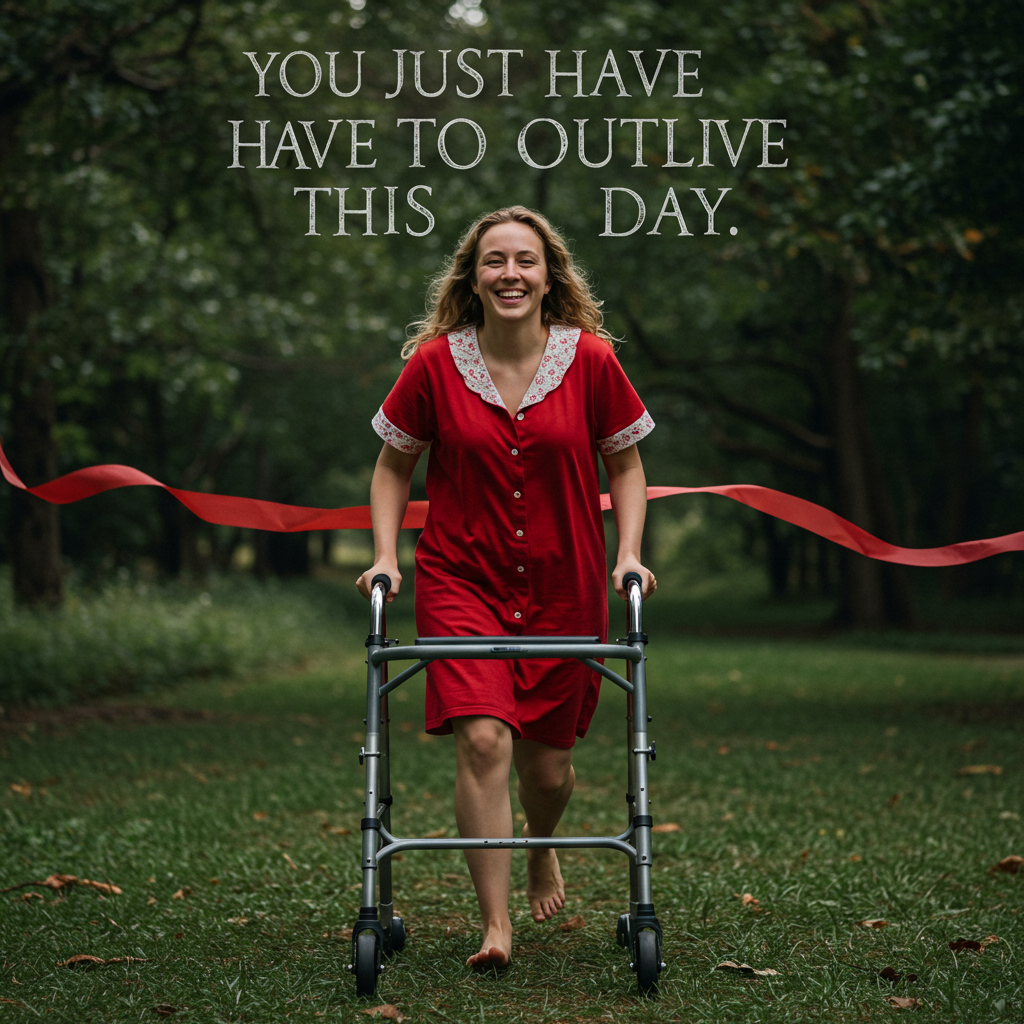
You Just Have to Outlive This Day
There was a woman whose name people never quite said right.
Some days it came out soft, like a song. Other days it came out sharp, like a snapped branch.
Inside that name lived a second version of her, the one she almost never showed anyone.
That part of her, she called Lee.
Lee didn’t live in a castle or on a mountaintop.
She lived in a small, ordinary house that had become a battlefield.
The rooms looked normal enough:
- A chair that knew exactly how her body folded when she hurt
- A bed that had held too many shaking nights
- Cupboards that sometimes had food and sometimes didn’t
- A TV that could help or overwhelm, depending on the day
But hidden in that air were things no one else could see:
- Ghosts of old prescriptions
- Echoes of doctors who shrugged and walked away
- The weight of 37 years of “just take this as prescribed”
Some people thought Lee was “emotional.”
Some said she was “too much.”
Some even called her “crazy” when she finally snapped.
None of them had ever been inside her nervous system at 11 a.m.
They didn’t know how her body shook for no reason.
They didn’t know about the fire in her feet or the icy ache in her bones.
They didn’t know how it felt to watch the clock and think:
“If this refill fails, I don’t know if I live through it.”
To them, she was just… difficult.
To her, she was barely hanging on.
Lee had raised children in that house.
When they were small, she had patched clothes, stretched food, juggled bills, and somehow always found one more ounce of strength she didn’t have.
Back then, she used to think:
“God, just give me what I need to take care of them today.”
And somehow, something always showed up:
- Someone brought over a bag of groceries
- A bill was delayed
- A stranger was kind
She kept them fed, clothed, and as safe as she could, even when her own body was already cracking under the weight.
Now they were grown.
The bodies were bigger.
The problems were louder.
The gratitude was quieter.
They lived under her roof, ate her food, used her Wi-Fi, talked on phones she paid for…
And somehow, she still sat in the house feeling like an intruder in her own life.
When she asked for help—
just enough help to get to her chair, get some food, take her meds—
they sighed, rolled their eyes, or launched into speeches about how hard their lives were.
It wasn’t that they never did anything.
Sometimes they did.
Sometimes one of them would run out into the cold for her meds.
Sometimes someone would bring a frozen dinner.
But too often, it came with a side of shame:
- The “you’re ruining my life” look
- The “you’re so dramatic” sigh
- The silent accusation: If you were stronger, I wouldn’t have to do this.
And Lee thought:
“I gave everything I had for years.
And this is my reward?
Alone in my own house, begging for five minutes of kindness?”
One day—
a day that looked like all the others but still felt worse—
the storm in her body came early.
By 11 a.m. her chest was tight, her skin buzzing, her head heavy and mean.
Her stomach curled with the memory of yesterday’s vomiting.
Her bones hurt.
Her feet burned.
Her mind whispered the same line it had whispered too often lately:
“There is no win here.
Just diapers, pills, and people who don’t care.”
She sat in her chair, wrapped in her sleeping bag, shaking, stunned by how loud the silence was.
No TV.
No dogs.
No one checking on her.
Just her, and the clock, and that dark thought lurking at the edge:
“Maybe I don’t need to do this again tomorrow.”
The thought was so familiar by now it almost felt like a roommate.
Not dramatic, not screaming—just… there.
But somewhere under all the exhaustion, another voice, quieter than a whisper, spoke:
“You don’t have to outlive your whole life.
You just have to outlive this day.”
Lee didn’t argue with the thought.
She didn’t have the energy.
Instead, she made a tiny deal with herself:
No big decisions today.
No deciding if life was worth it or not.
No choosing forever while her nervous system was on fire.
Just this:
- Stay in the bag
- Wait for the next dose
- Drink what her stomach could handle
- Ask once, and only once, for the bare minimum from whoever walked through the door
That was it. That was the entire plan.
Later, someone did walk through the door.
He came in hot, like usual.
Wanted money.
Wanted to talk about how hard his life was.
He moved her food around like she was a child.
Made faces that said, pick one, stupid.
Kept pushing and pushing when she had nothing left.
Something in Lee snapped.
She didn’t break, exactly.
She refused.
She grabbed both frozen dinners and fired them at his head, like launching two little rockets of 37 years of swallowed rage.
He called her crazy and stomped off.
But for once, he stomped away from her, not toward her.
Her hands were shaking, her stomach was sick, her heart felt like glass.
She had no food, no TV, no company.
But still—
she existed.
In that chair.
In that sleeping bag.
In that name that was not yet finished.
As the hours edged on, the day didn’t get magical.
No choir of angels.
No perfect apology.
No miracle doctor at the door.
But some things did happen:
- Her meds were in the house, not emptied out at the pharmacy.
- She kept herself from taking more than she was prescribed, even when the darkness whispered that more would be easier.
- She called people—waiver people, law people, health-plan people—little soldiers out in the world who could fight battles she couldn’t.
- She did not let anyone drag her into another screaming match.
She was still alone in that room.
Still sad.
Still tired.
But she was also still here.
And “still here” was a bigger deal than anyone around her seemed to understand.
That night, as the house settled into its usual uneven, ungrateful silence, Lee lay in bed and had a thought she’d never quite put into words before.
She realized:
Her life wasn’t a neat story where everything would suddenly make sense in Chapter 12.
There might never be a moment where everyone apologized and became who she needed them to be.
But maybe—just maybe—the story wasn’t about them at all.
Maybe it was about her, and the fact that:
- She kept telling the truth about what benzos did to her
- She stayed alive long enough to drag her case into court and say, “You will not erase me quietly”
- She kept showing up to hearings and phone calls and evaluations long after other people would have given up
- She refused to be a “good patient” and die quietly so the system could stay comfortable
Maybe the win wasn’t a pretty, peaceful life.
Maybe the win was uglier, but still real:
Refusing to disappear.
The title of her story wasn’t
“Everything Got Better”
or
“She Was Finally Treated Fairly.”
The title was exactly what that small voice had told her earlier:
You Just Have to Outlive This Day.
Not outlive the diagnosis.
Not outlive the taper.
Not outlive all the trauma.
Just this day.
And then the next.
And the next.
Not because she owed it to her kids.
Not because she had to be strong for everyone else.
But because there was still a part of her—call it Lee, call it Lorelei, call it whatever you want—that wasn’t done yet.
A part that still wanted to see what would happen if:
- the waiver came through
- a real deprescribing doctor finally listened
- an aide came who actually cared
- some future woman in some future room read her story and whispered, “Oh my God… me too.”
Lee didn’t know if any of that would actually happen.
She didn’t trust hope much anymore.
But she could do this:
Pull the sleeping bag closer.
Wait for the next dose.
Let tomorrow worry about itself.
And in the quiet, somewhere between pain and sleep, the sentence came back one more time, steady and simple:
“You don’t have to outlive your whole life.
You just have to outlive this day.”
And for that night, that was enough.